Two reports published this month got me thinking, and I would like to share what they suggest to me.
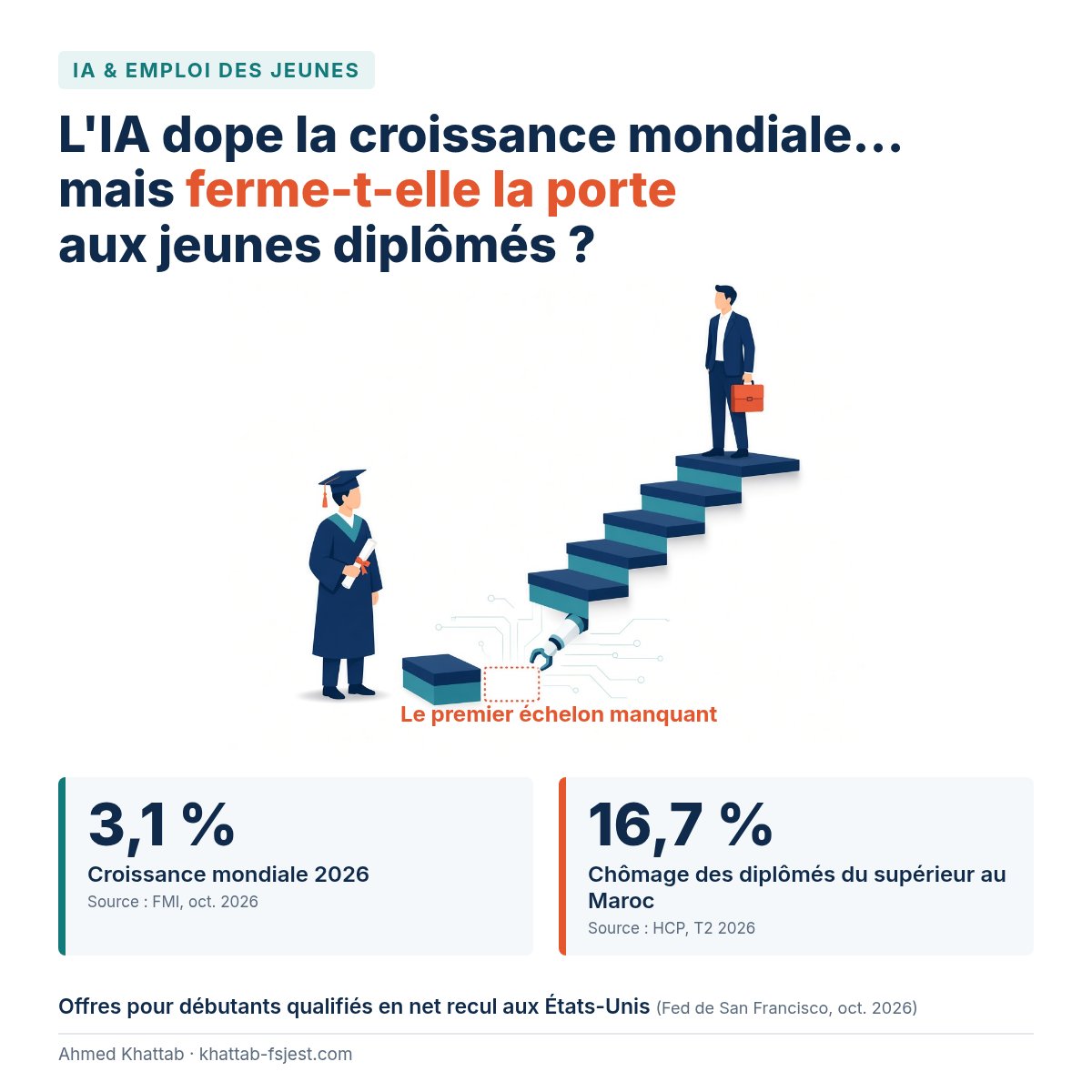
On 13 October, the IMF projected global growth of 3.1% in 2026 and 3.4% in 2027, driven in large part by investment in artificial intelligence. Yet it also describes a “split” world economy: energy-importing countries with little presence in technology value chains are the most exposed.
Two days later, the San Francisco Fed observed that, so far, AI has had little effect on total employment in the United States. One detail stands out, though: for jobs that require at least a college degree, postings for entry-level positions have fallen sharply over the past three years, while those for mid-level and senior profiles have held steady.
This will not surprise anyone who works on technical change. A new technology never affects everyone in the same way. AI first takes over the most codifiable tasks, which are precisely the ones usually given to new hires: a summary, a first draft of a report, a spreadsheet to format. But doing these tasks is how people learn the job. A senior employee is productive because they were once a beginner. If the first rung of the ladder disappears, I wonder who will train tomorrow’s experts.
In Morocco, the new HCP survey (second quarter of 2026, based on ILO standards and not comparable with the previous one) puts unemployment at 9.5%, but at 27.2% among 15–24-year-olds and 16.7% among university graduates. We should be careful: nothing suggests that AI explains graduate unemployment, whose causes go back much further, starting with the mismatch between education and jobs. But if what we see in the United States spreads, it will add to a difficulty that is already very real.
I think we should look at internships, work-study programmes and first jobs as a collective investment in experience, not as a cost.
What do you think? If AI replaces beginners’ work first, how will young people gain the experience that makes senior workers productive?
- IMF, World Economic Outlook, October 2026: https://www.imf.org/-/media/files/publications/weo/2026/october/english/execsum.pdf
- Federal Reserve Bank of San Francisco, FedViews, 15 October 2026: https://www.frbsf.org/research-and-insights/publications/fedviews/2026/10/sf-fedviews-october-15-2026/
- HCP (High Commission for Planning), Labour Force Survey, Q2 2026: https://www.hcp.ma/attachment/2897232/